

























Cybercrime in Bangladesh: Rising Threats, Financial Fraud, and Victim Statistics
Cybercrime is surging in Bangladesh, with nearly 200,000 complaints over five years. Learn about the latest trends in financial fraud, e-commerce scams, AI-driven threats, and police efforts.


Cybercrime is on the rise, with the number of complaints and victims increasing as criminals adopt increasingly sophisticated tactics to deceive the public.
According to data from the Criminal Investigation Department (CID) and the Detective Branch (DB) of Dhaka Metropolitan Police (DMP), nearly 200,000 people have reported cybercrime incidents over the past five years. In the current year alone, around 5,000 complaints have been submitted to the DB, with most targeting financial assets.
Dhaka Metropolitan Police Additional Commissioner (DB) Shafiqul Islam emphasized that law enforcement is actively investigating cases and taking steps to bring perpetrators to justice. He also highlighted the importance of public awareness in combating cybercrime.
CID records show that 178,596 complaints were filed since 2020, and in the past six months, 3,766 victims contacted the Cyber Police Centre. CID spokesperson Superintendent of Police Jasim Uddin stated that reports are received daily, and each complaint—submitted online or through verified channels—is being thoroughly investigated.
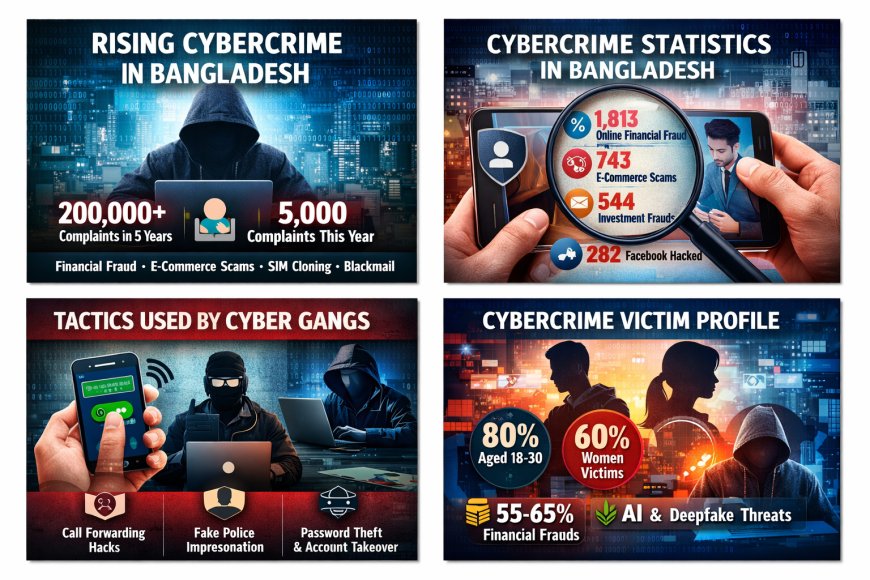
Analyses of DB complaints reveal that cyber gangs are systematically stealing money and sensitive information from smartphone users nationwide, including in Dhaka. Criminals often impersonate senior police or government officials, extorting large sums by threatening false legal action or offering to settle cases. They sometimes use images of people in official uniforms to deceive victims.
Police cyber specialists warn that these gangs are now more organized and audacious. Common tactics include changing call-forwarding settings on victims’ phones, altering mobile banking information, and redirecting passwords to their own accounts before siphoning money.
Recently, a gang member named Durjoy admitted to DB investigators that he would call strangers from various numbers, gather information, and use it to commit financial fraud.
CID data over the last six months shows 3,766 complaints: 1,813 from online financial fraud, 743 via e-commerce deception, 544 through investment scams, 64 through loan fraud, and 115 while seeking services. Other cases include freelancing-related loss (13), national ID issues (17), posts/messages/photos/videos misuse (802), false personal information (61), private data leaks (12), Facebook hacks (282), blackmail (187), SIM cloning (165), and other cyber offences (261).
Officials confirm that investigations are ongoing for all complaints, and advice has been provided to 2,552 victims. Experts say cybercrime remains difficult to control due to its domestic and international nature, requiring coordinated action.
A study by US cybersecurity firm Mandiant revealed that 55% of 2024 cyberattacks aimed at financial gain. Taposi Rabeya, deputy director of BLAST, noted that many educated city residents face online sexual harassment, but 15–25% do not report these incidents.
At an event hosted by Dhaka Reporters Unity, the Cyber Crime Awareness Foundation reported that nearly 200,000 complaints were filed over five years, representing only about 12% of actual victims. Surveys show that 80% of victims are aged 18–30, with women comprising 60%. The growing use of AI and deepfake technology is further escalating cybercrime. Police data indicates that 55–65% of cybercrime involves financial fraud, with both the frequency and types of offences rising annually.
What's Your Reaction?
 Like
0
Like
0
 Dislike
0
Dislike
0
 Love
0
Love
0
 Funny
0
Funny
0
 Angry
0
Angry
0
 Sad
0
Sad
0
 Wow
0
Wow
0